Baccarat it attracts over 70% of members thanks to its fast-paced gameplay and extremely high win rate of 49%. The simple scoring rules make it easy for you to master every game from the very first time you play. Follow along! BAY789 analyze the rules of the game in detail to optimize your betting strategy today.
Where did baccarat originate and how did it develop?
At bay789 , The history of the development of the subject of cards baccarat having undergone many impressive transformations over the centuries. Understanding its origins allows players to fully appreciate the aristocratic culture embedded in each game. Let’s explore the key milestones that have shaped this prestigious game.

The game originated in Italy in the 15th century, created by the dice maker Felix Falguiere based on ancient Tarot cards. Baccarat in old Italian, it means zero, representing the value of the human-shaped playing cards. The game quickly spread due to its simple yet intellectually stimulating competitive nature.
The 19th century saw a strong influx of this card game into the French aristocracy during the reign of King Charles VIII. The Chemin de Fer version became an exclusive form of entertainment in luxurious royal tea houses. This acceptance from the upper class propelled the game to spread throughout Europe.
Its appearance in Las Vegas casinos in the 1950s transformed the game into an international standard. Operators refined the rules to optimize playing time for all participants. Today, this game holds a dominant position in both online and traditional casinos.
BAY789 updates the baccarat rules and detailed scoring methods
Mastering the fundamental rules is a crucial first step in confidently conquering any betting table. The system of rules is meticulously designed to ensure fairness for both participants. Please remember the detailed operating steps Baccarat below to avoid making regrettable mistakes.

The purpose of a baccarat game
The core objective is to accurately predict which side will have a total score closest to 9. You don’t directly compete with the dealer; your role is simply to predict the outcome of the two hands. Analyzing the probabilities of these outcomes helps members make informed betting decisions. This includes:
- The system offers three main betting options: Banker, Player, and Tie. Each bet has a completely different probability of occurring and a different payout ratio on the betting table.
- Winning occurs when your chosen hand has a higher score than your opponent after the cards are dealt. If both sides have equal scores, the bets on Banker and Player will be fully refunded. Conversely, those who bet on Tie will receive a huge profit.
Rules for dealing cards by the dealer and drawing a third card
When the game begins baccarat the dealer will then deal two hole cards to both the Player and the Banker. The cards are face up and displayed publicly on the table so that all players can easily see the scores. The initial total of these two cards directly determines whether to draw another card or stop.
- The rule for a natural stop applies immediately when either hand reaches a total of 8 or 9 points from the first two cards. This state instantly ends the game without dealing any more cards.
- The Player baccarat will automatically draw a third card if the total of the first two cards is between 0 and 5 points. If the Player reaches 6 or 7 points, the system will immediately stop drawing cards. The Player’s decision to draw cards is made first and serves as the basis for the Banker’s review.
- The Banker’s third card drawing rule depends on the Banker’s current total points and the value of the Player’s third card. If the Banker has 0-2 points, they always get to draw, while a 7-point score means they stop immediately. This complexity creates a slight probabilistic advantage for the Banker.
How the scoring system works in baccarat
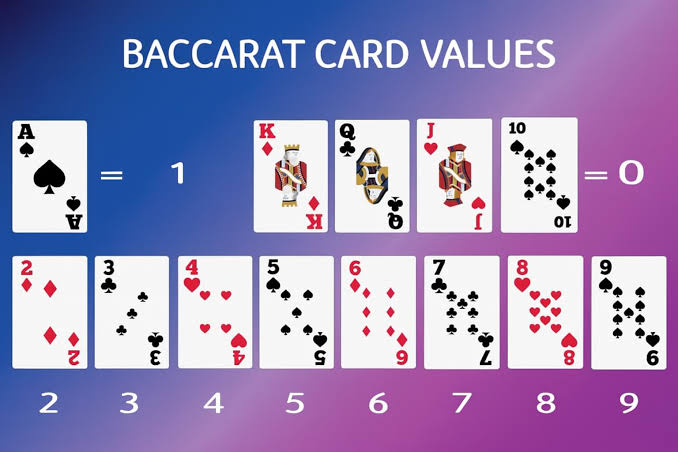
The value of each card is clearly defined, allowing for quick and accurate point calculation. Cards from 2 => 9 retain their face value. Cards 10, J, Q, and K are counted as 0 points, while the Ace has a value of 1 point.
The total score of a bet in the game is always taken from the units digit of the total value of the cards. If the total of the cards exceeds 9, the tens digit is completely discarded. The valid score for a bet always ranges from 0 to 9 points.
Consider a real-world example: when the Player receives a 7 and an 8, the total value is 15 points. According to the rule of discarding the tens digit, the official score for this hand would be 5 points. Understanding this addition formula helps you quickly predict the outcome of the game.
Payout ratios for different betting options
Each betting box in the game baccarat each option has its own unique payout ratio and risk level. Understanding these detailed parameters helps members optimize their investment capital in each game. The table below will specifically analyze the payout ratio and characteristics of each option.
| Betting odds | Payout ratio | Commission fee | Features & Practical Notes |
| Banker’s Hand (House Hand) | 1:0.95 | 5% of winnings | With the highest win rate, this safe investment option is preferred by many experienced traders. |
| Player’s Door | 1:1 | 0% (No charge) | If you bet 100k and win, you’ll get exactly 200k (including both capital and profit), the probability of winning is slightly lower than with Banker. |
| Tie Door | 1:8 or 1:9 | 0% (No charge) | The potential for a sudden profit is high, but the probability of it occurring is quite low (only about 9.5% of the total number of games). |
| Side Door (Banker/Player Pair) | 1:11 | 0% (No charge) | The requirement is that the first two cards of each side form a pair of the same value. |
| Side bet (Over/Under) | 1:0.54 to 1:1.5 | 0% (No charge) | Based on the total number of cards drawn on the table (4 cards or 5-6 cards). |
Baccarat terminology players need to understand before betting.
The system of specialized terminology serves as a common language across all online and traditional betting platforms. Memorizing the symbols helps members easily track statistics and make accurate decisions. The summary table below will decode the core concepts in detail for you.

| Terminology | Detailed meaning | Practical applications |
| Commission | A 5% fee is deducted when the Banker bet wins. | The bookmaker automatically deducts the amount from the bonus. |
| Shoe | The plastic box contains 6 to 8 mixed decks of cards. | The dealer uses this to draw cards and deal them to each player. |
| Burn Card | The card is discarded before starting a new deck. | Ensure randomness, avoid shuffling patterns. |
| Big Road | Main results record in the form of a large line | Helping players predict winning numbers, consecutive numbers, and combinations. |
| Big Eye Boy | The supplementary chart shows the fluctuations of the Big Road. | Use rhythm analysis of the results |
| Small Road | Small line chart predicts the next trend | Helping members increase the accuracy of their bets. |
| Cockroach Pig | The Cockroach Ball Table provides a different statistical perspective. | Compare data to find recurring patterns. |
| Bead Plate | Table showing historical results in granular form | A detailed analysis of each bet that took place. |
| Ping Pong | The match results alternate between Banker and Player. | The Martingale betting strategy is based on the rhythm of the bridge. |
Conclude
Department baccarat its appeal stems from the perfect combination of luck and strategic capital management. Mastering the rules of card dealing and how to read the results table significantly increases the winning rate for members. Apply this knowledge immediately to confidently conquer the betting halls https://bay789.sh/ excellent!