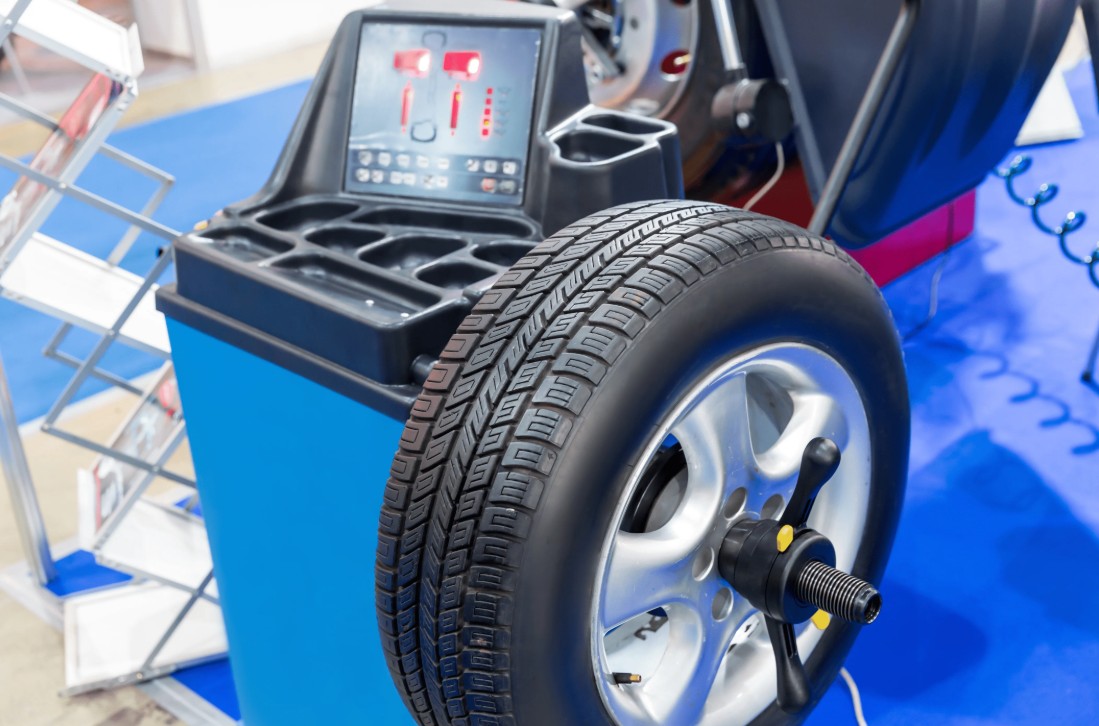
Across Canada, the automotive trade follows the seasons: every autumn and spring, driveways and service bays fill as motorists swap between summer rubber and winter tires. A busy Ontario or Alberta shop can mount hundreds of tires in a single October week, and each fresh assembly must be checked before it returns to the road, which is why the wheel balancer is one of the hardest-working machines in any garage.
Yet many drivers never learn why a wheel that looks perfectly round can still rattle a steering column at one hundred kilometres per hour. The answer lies in a small amount of physics that turns violent once a wheel is spun to road speed.
No wheel is ever perfectly even
A tire and rim are manufactured to close tolerances, but never to perfection. Rubber thickness varies, the valve stem adds mass on one side, and the metal of the rim is not perfectly symmetrical.
Why a tiny heavy spot becomes a big vibration
When any mass is spun in a circle, centrifugal force flings it outward, and that force grows with the square of the rotational speed: double the speed and the outward pull quadruples.
The familiar comparison is a washing machine with a wet towel bunched on one side of the drum: gentle at first, then a thumping shudder as the spin accelerates. A car wheel does the same, sending the pulse through the suspension into the steering wheel.
How the machine locates the heavy spot
A wheel balancer clamps the wheel onto a horizontal shaft and spins it to a controlled speed. As it turns, sensitive transducers read the tiny cyclic forces the heavy spot produces, and their timing reveals precisely where the extra mass sits and how much of it there is.
The machine then tells the technician where to clip small counterweights onto the rim. Adding mass opposite the heavy spot evens the distribution, so the outward pulls cancel and the wheel spins smoothly. This is the entire job of a wheel balancer, translated from raw vibration into a clear instruction.
Two ways to balance, and why the difference matters
Balancing is classified by method. Static balancing works in a single plane, as though the wheel were a flat disc; it cures the up-and-down bounce but not side-to-side wobble.
The stakes are real. An unbalanced wheel scrubs the tread unevenly, shortening tire life and cupping the rubber, while the constant vibration wears wheel bearings and tie-rod ends.
Why a machine must check itself
Because a wheel balancer measures forces of only a few grams, its own reference must stay honest. A self-calibrating design checks and corrects that internal reference automatically, so a worn bearing or a slight knock does not quietly skew every reading.
•Static balance: single-plane, cures vertical bounce only
•Dynamic balance: two-plane, removes bounce and shimmy
•Counterweights: clip opposite the heavy spot
•Self-calibration: keeps gram-level readings trustworthy
A Manitoba shop fitting winter wheels to a family sedan sees the value at once: a wheel balanced to a fraction of a gram means a quiet, steady drive through the snow and tread that lasts the full season rather than wearing out one shoulder before spring.
Understood this way, the machine is less a mystery than a careful listener, reading the small forces a spinning wheel cannot hide and turning them into a simple map of where to add weight, and that is precisely why the wheel balancer remains essential to safe, comfortable, long-lasting tires.